 Español
 English
 Italiano
 Français
 Deutsch


Arco de las Peñitas: the stone bridge hidden in the ravine
The Arco de las Peñitas is the most photographed formation in the interior of Fuerteventura and, at the same time, the hardest to find. It is a natural bridge of syenite — a rock similar to granite — that erosion has slowly hollowed out over millions of years until it left a perfect arch suspended above the ravine.
It sits in one of the oldest massifs in the Canaries, in the Barranco de las Peñitas, and from beneath the arch you can see the whole valley and, down at the bottom, the little Ermita de la Peña. That combination — pale rock, blue sky and a white chapel below — is the reason people make the climb.
A warning up front, because it is the key to this one: there is no official path that reaches the arch. It is the most technical route in our guide.
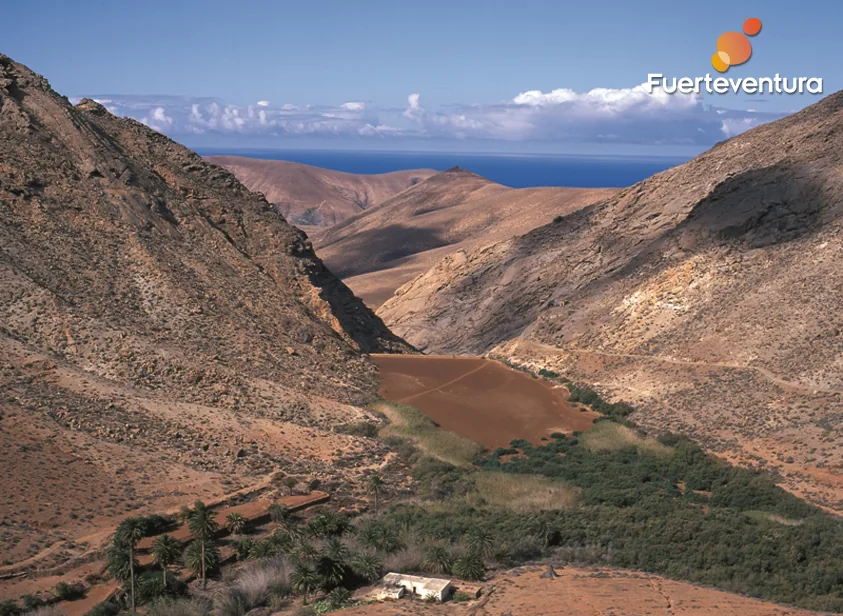
How to get to the Arco de las Peñitas
The starting point is the village of Vega de Río Palmas, in the municipality of Betancuria, right in the middle of the island.
in the car park in the village of Vega de Río Palmas. Everything from there is on foot.
10 minutes by car.
about 35 minutes.
around an hour and an hour and a half respectively.
The route, step by step
Total time: between 1 hour 30 and 2 hours there and back.
- 1The ravine
From the village you enter the Barranco de las Peñitas along an obvious track that follows the bed of the ravine. This first section is comfortable and impossible to get wrong.
- 2The Ermita de la Peña
It appears tucked into the bottom of the valley, at the foot of the ravine walls. This is the sanctuary of the Virgen de la Peña, patron saint of Fuerteventura, and in September it fills up for the island’s best-attended pilgrimage. For the rest of the year it is a silent spot and a good place to turn back if you would rather not climb.
- 3The climb to the arch
This is where the easy going ends. You have to head up the slope on the right, with no clear path, and do a little scrambling over the rocks on the final stretch. It is not climbing, but it does mean using your hands and being sure-footed.
What you need for the climb (and when not to do it)
boots or trail shoes. You will not get up in smooth-soled trainers or flip-flops, and coming down is worse than going up.
the ravine is a funnel with no shade, and the heat inside it can be fierce even on mild days.
there are stretches with no signal.
Better not to go alone if you are not used to moving over ground without a path.
When to give it a miss: after rain — Canarian ravines turn dangerous and the rock gets slippery — and in the middle hours of a hot day. The sensible plan is to set out first thing in the morning.
If the scramble doesn’t appeal, the visit is still worth it: the ravine and the chapel make an easy hour, and you can make out the arch from below.
What to see nearby
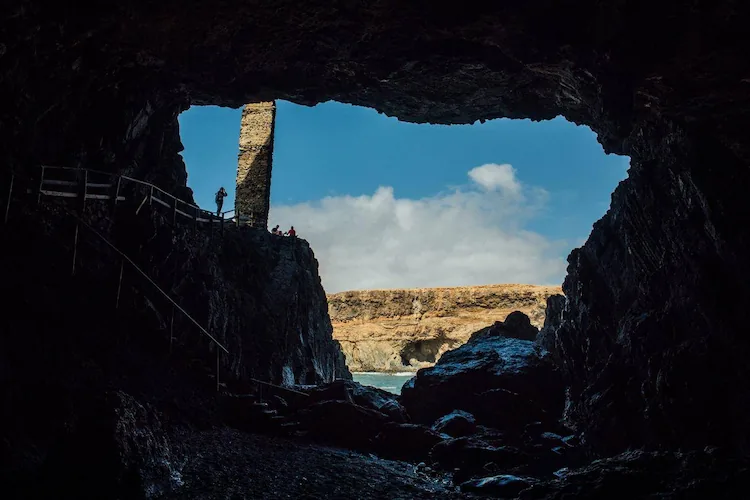
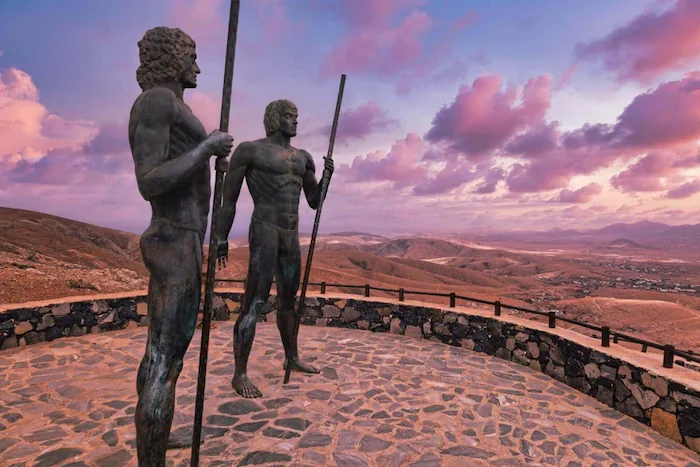
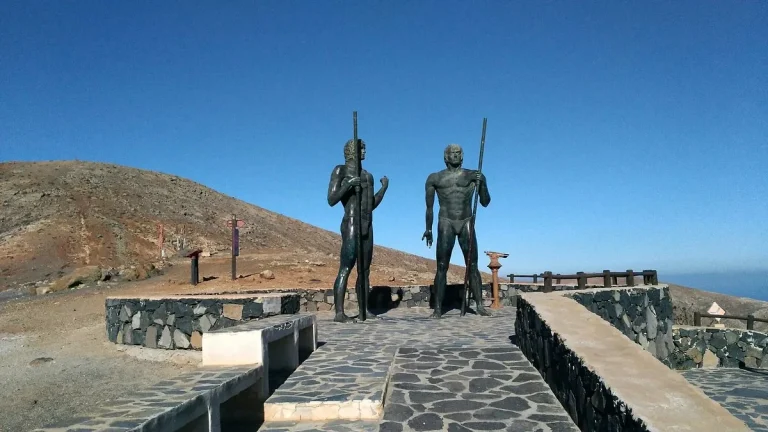
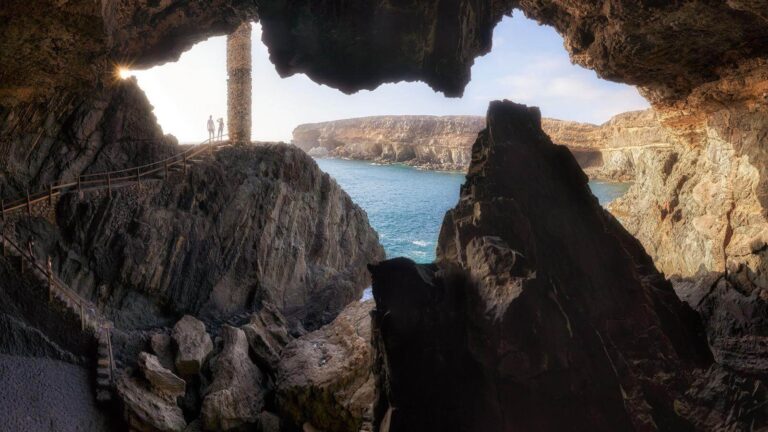
You are in the heart of the massif, so everything else is within reach: Betancuria ten minutes away, the Guise and Ayose viewpoint on the same FV-30, and the Ajuy Caves down on the west coast. A morning in the ravine and an afternoon on the cliffs is one of the best days the island can give you; it is laid out in the 5-day route and in what to see in Fuerteventura.
Frequently asked questions about the Arco de las Peñitas
How do you get to the Arco de las Peñitas?
Park in Vega de Río Palmas and walk in along the Barranco de las Peñitas as far as the Ermita de la Peña. The arch is up above, on the right-hand slope, and the last stretch is done with no marked path, scrambling over rock.
How long does it take?
Between an hour and a half and two hours there and back to the arch. If you stop at the chapel, an hour is plenty.
Is it a dangerous route?
It is not technical in the climbing sense, but it is not a route for everybody: there is scrambling, there are no signs and there is a drop. With the right footwear, no rush and the midday heat avoided, it is perfectly manageable for anyone used to walking in the hills.
Can you do it with children?
As far as the chapel, yes, and it is a lovely walk. As far as the arch, no, not with small children.
Is there a fee or a permit?
No. Access is free and unrestricted and no permit is needed. There is no ticket office, no opening hours and no checkpoint.
Is there water, a toilet or a bar on the route?
On the route, nothing. You have to carry your water up from the village. In Vega de Río Palmas and in Betancuria you will find somewhere to eat.
Can you see the arch without climbing?
You can make it out from the ravine, but the photo everybody is after — the arch framing the valley — can only be had from the top. If you are going for the photo, count on the scramble.
What is the best time of day to photograph it?
First thing in the morning, which is also the safe hour as far as the heat goes. The low light comes through the gap in the arch and separates the pale rock from the sky.
Keep exploring