 Español
 English
 Italiano
 Français
 Deutsch


Playa de Cofete: twelve kilometres of sand with nothing around it
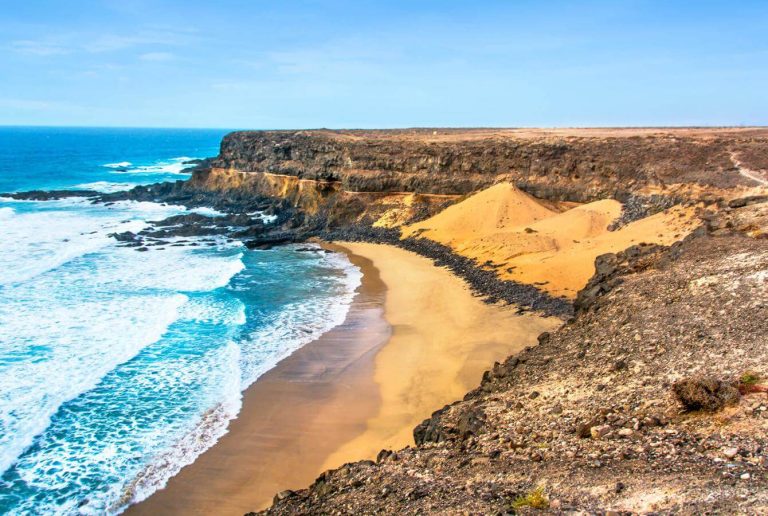
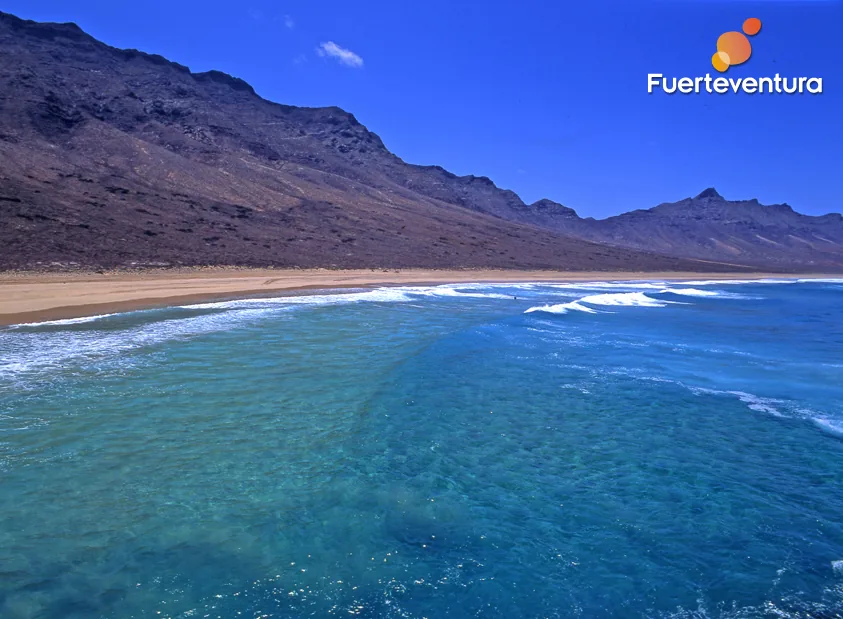
There are beautiful beaches, and then there is Cofete. Twelve kilometres of sand open to the Atlantic, on the northern face of the Jandía peninsula, inside the Jandía Natural Park, with a wall of mountains more than 600 metres high at its back and not a single building in sight beyond a handful of houses and one mysterious mansion up on the hillside.
It is, by a distance, the most impressive landscape in Fuerteventura and one of the few in the Canaries left unbuilt. It is also the most demanding to visit: you get there along a dirt track some 20 kilometres long and the swimming is frankly dangerous. It is worth knowing that before you set off.

What the sand is like and, above all, what the sea is like
The sand is golden verging on pale, fine and clean, and the beach is so wide that even on the busiest days you can walk for ten minutes and have it to yourself.
The sea is another matter. Cofete is wide open to the north Atlantic: the waves break hard over a beach break of shifting sandbanks, there are rip currents and the sea bed drops away differently from one day to the next. There is no lifeguard anywhere along the beach and the mobile signal is patchy.
Put plainly: Cofete is not a swimming beach. You can get your feet wet at the water’s edge when the sea is calm, and not much more. If what you want is to swim, you have it an hour away at Sotavento or Jandía, both on the same peninsula and both sheltered.
How to get to Cofete
Access is from Morro Jable, along a dirt track of about 20 kilometres that crosses the massif by the Degollada de Cofete and zigzags down into the valley.
between 45 minutes and an hour each way, because of the state of the surface and the bends. Allow half a day for the whole outing.
here comes the important warning. Almost every company expressly forbids driving on dirt tracks in its terms, and a puncture or a knock to the underside of the car at Cofete is not covered by the insurance. Check before you decide.
there are 4×4 transfer services from Morro Jable that make the trip several times a day. It is the sensible option if you would rather not risk the car, and it also lets you look at the landscape instead of the track.
before you drop down, at the top of the pass, there is a viewpoint that takes in the whole beach. Plenty of people would say that view alone justifies the journey.
La Casa Winter and the cemetery
Above the beach, isolated on the hillside, stands the Casa Winter, a large house built in the middle of the twentieth century by the German engineer Gustav Winter. Its appearance, its isolation and the period in which it went up have fed every kind of legend – submarines, Nazi fugitives, clandestine landing strips – none of which has ever been proved. We tell the whole story in our piece on the Casa Winter.
Near the beach there is also the small cemetery of Cofete, with its white crosses facing the ocean. It is one of the most photographed corners of the island and deserves to be visited with the respect it is due.
What to bring
At Cofete there is absolutely nothing: no showers, no toilets, no lifeguard, no shade, no shop. There are a couple of very basic places in the hamlet, and that is all.
Water, far more than you think. That is the classic mistake.
Food, if you are going to make a day of it.
there is nowhere to get out of the sun.
this is the north coast and it blows almost always.
this is a protected area and there are no bins. Read up on the rules for protected areas before you go.
When to go
The best light is first thing in the morning, when the sun climbs behind the massif and the whole beach is held in a golden half-light, and then late in the afternoon. At midday the contrast is harsh and the heat on the track is considerable.
Avoid driving down after rain: the track turns to mud and the ravines it crosses can carry water. And set off with plenty of time to get back in daylight; the track at night is no place for a first attempt.
What to see nearby
Cofete strings together naturally with the rest of the south: Morro Jable and its lighthouse, the Playa de Jandía and, heading up towards Costa Calma, the Sotavento lagoon. It is built into our 5-day itinerary and into the guide to what to see in Fuerteventura.
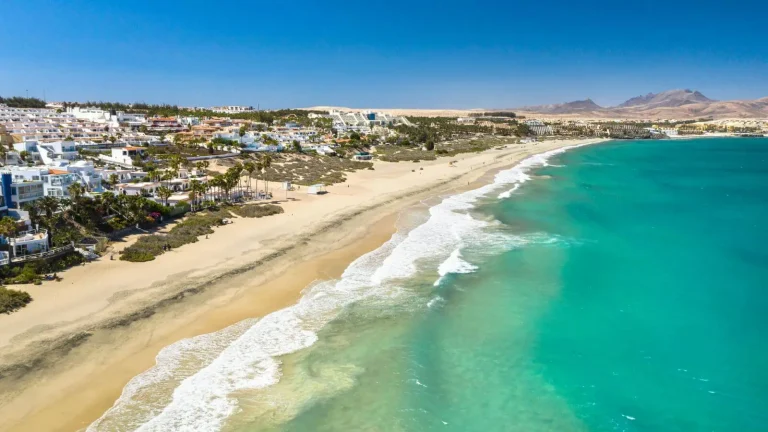
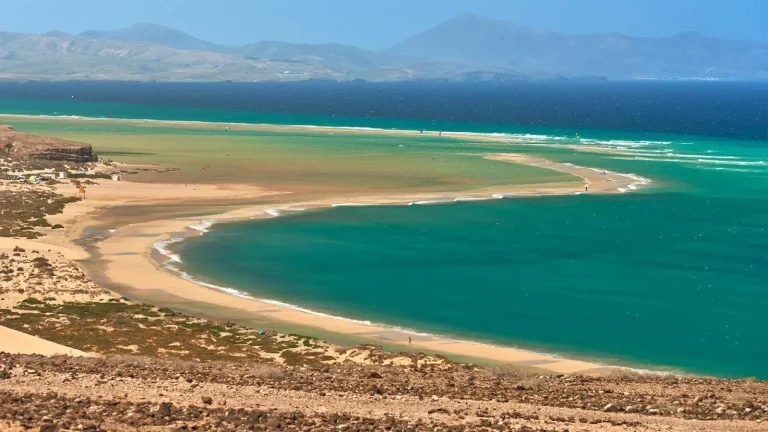
Frequently asked questions about Playa de Cofete
Can you get to Cofete in an ordinary car?
Physically yes, carefully and slowly: ordinary cars do the track every day. The problem is contractual: most hire companies forbid driving on dirt tracks and void your cover. Check your terms or take a 4×4 transfer from Morro Jable.
How long does it take to get there?
Between 45 minutes and an hour from Morro Jable, one way. Count the outing as half a day.
Can you swim at Cofete?
It is not advisable. There is heavy surf, there are rip currents and there is no lifeguard, and the sea bed shifts constantly. You come to Cofete to see the landscape and to walk, not to swim.
Are there bars or facilities?
Practically nothing: a couple of very basic places in the hamlet, and no showers or public toilets on the beach. You need to come self-sufficient.
What is the Casa Winter?
A large house built in the middle of the twentieth century by the German engineer Gustav Winter on the hillside above the beach. Its isolation has generated legends that have never been proved; the full story is here.
Is it a nudist beach?
Given its size and its emptiness, nudism is practised quite naturally on the stretches away from the access point, as it is on a good number of the island’s unspoilt beaches.
Is the trip worth it?
If you have come looking for a comfortable swim, no. If you have come to see the most imposing landscape in Fuerteventura, without question: there is nothing like it in the archipelago.
Keep exploring