 Español
 English
 Italiano
 Français
 Deutsch


Ajuy Caves: the oldest rocks in the Canaries
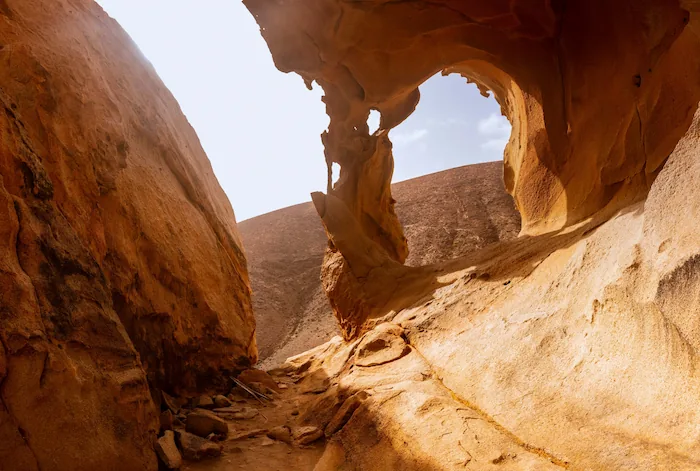
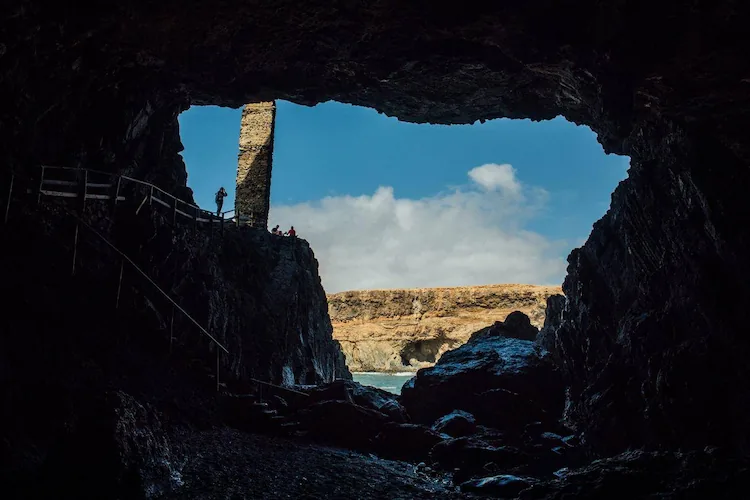
On the west coast of Fuerteventura, at the end of a ravine and behind a fishing village of half a dozen houses, lie the Ajuy Caves: enormous sea caves cut into a cliff of pale stone, reached by a path suspended above the Atlantic.
What makes them unique is not the size, impressive though that is, but the rock. This cliff is part of the basal complex, the oldest material in the archipelago: ocean floor pushed upwards when the islands did not yet exist as such. Put another way, here you can touch what was there before the Canaries were born. It is the only place on the island where that is so easy to see.
And to round off the contrast, the path starts on a black sand beach with a sea that is nearly always rough.
How to get to Ajuy and where to park
Ajuy belongs to the municipality of Pájara, on the west coast, and you reach it by dropping down the ravine from the interior of the island.
about 30 minutes through the interior. It is the most natural pairing: Betancuria in the morning and Ajuy afterwards.
around an hour.
a good hour and a quarter, and from Morro Jable a little over an hour.
the village has a car park right by the beach, free but small. In high season and at midday it fills up, and then you have to leave the car at the entrance to the village and walk down for a few minutes.
The path: 45 minutes between cliffs and lime kilns
The walk is short, it has been made up properly and there is no technical difficulty. It takes about 45 minutes there and back, stopping to take photos.
Where it starts: on the black sand beach, on the right-hand side as you look out to sea. There are stone steps and handrails along almost the whole route.
The lime kilns. Halfway along, two stone structures appear that many people walk straight past, assuming they are just any old ruins. They are nineteenth-century lime kilns: the limestone from the cliff was burnt here and the lime was shipped out from the beach itself. That was the trade that gave the village its life.
The viewpoint and the descent into the caves. The path carries on to a balcony above the cliff and from there drops down to the mouth of the caves by a flight of steps.
The tide: what decides whether the visit is good or dangerous
This is the most important thing on the whole page. These are active sea caves, not a dry ruin, and the sea goes into them.
At low tide you can go down inside and walk through them comfortably. That is the visit everyone wants.
At high tide or with a heavy swell the spectacle from above is far more impressive — the waves rush in and burst inside — but going down is dangerous. You have to watch from the viewpoint, and that is not up for debate.
It is worth checking the tide table on the day itself before setting out. On this coast the Atlantic gives no warning, and the rocks on the way down are slippery even when they look dry. Have a look too at the rules for protected areas: this is one of them.
What to bring
Closed shoes with grip. No flip-flops: there are stone steps and damp sections.
Water and a hat. The path has not a scrap of shade and the pale stone reflects the sun.
A windbreaker. This is the west coast, open to the Atlantic, and the wind blows almost constantly.
A camera or a charged phone. The best light for the caves is late in the afternoon, when the sun shines straight into the mouth of the caves.
What to see near the Ajuy Caves
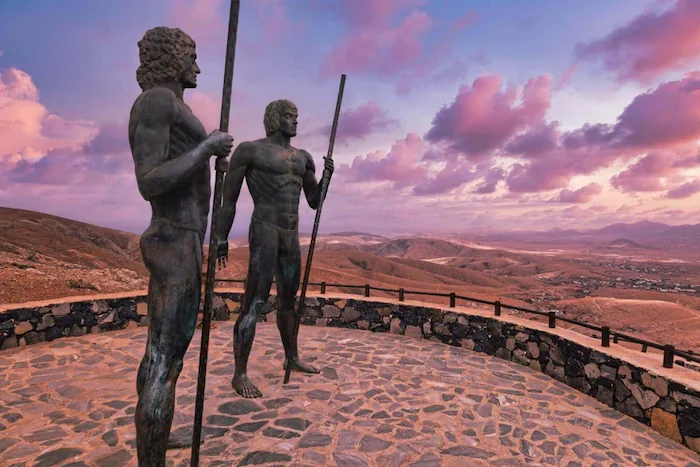
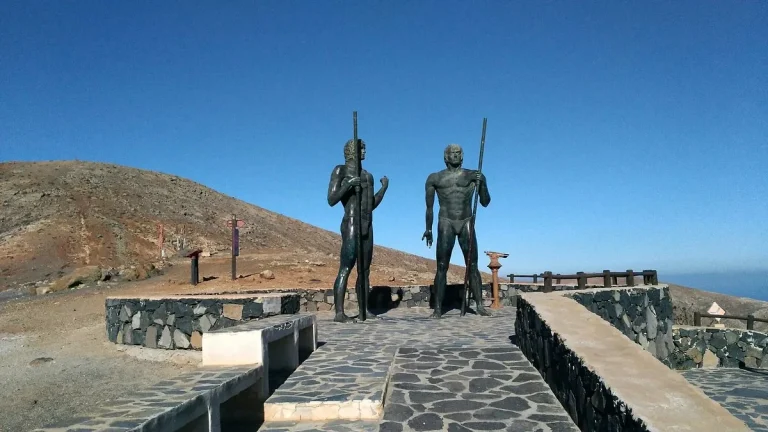
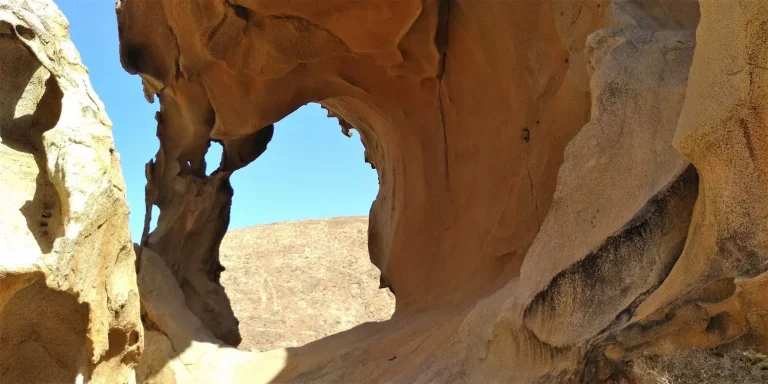
Ajuy fits neatly into the route through the west and the interior. Half an hour away are Betancuria and the Guise y Ayose viewpoint; a little closer, in Vega de Río Palmas, is the start of the walk to the Peñitas Arch. And if you want to keep going down the west coast, the next big stop is Cofete Beach. All of it is threaded together in the guide to what to see in Fuerteventura.
Frequently asked questions about the Ajuy Caves
How much does it cost to visit the Ajuy Caves?
Nothing. Access and the path are open and free, and so is the village car park. There is no ticket office and no closing time.
Can you go inside the caves?
Yes, when the tide is out. At high tide, or with a heavy swell, the descent becomes dangerous and you have to stay at the viewpoint above. This is not over-cautious advice: the sea comes in with real force.
How long does it take to walk there?
Between 15 and 20 minutes from the beach to the caves, and about 45 minutes for the whole round trip with stops.
Is it a difficult walk, or suitable for children?
The path has steps and handrails and is suitable for most people, children who walk well included. What is not suitable is the final descent inside the caves with small children, because of the slippery rocks.
Are there bars or toilets in Ajuy?
Yes. The village is tiny but it has several restaurants right by the beach, specialising in fresh fish, which is another good reason to come. There are ideas for the rest of the island in where to eat in Fuerteventura.
Can you swim at the beach in Ajuy?
Only with great care and only on days when the sea is calm. This is a west coast beach, with strong waves and currents, and it is not the place for a quiet swim. If that is what you are after, Playa de La Concha, in the north, is a better bet.
Why is the sand black here and white in Corralejo?
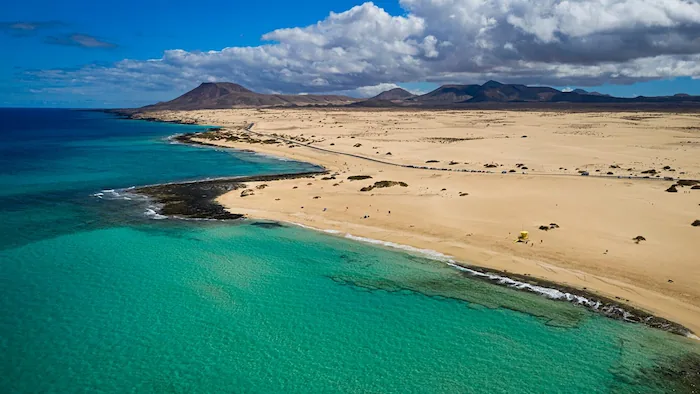
Because they have different origins. The sand in Ajuy is volcanic sand, from the erosion of the basaltic rock in the area. The sand of the Corralejo Dunes is of organic origin, made of ground-up shells and marine organisms.
What is the best time of day to go?
Whichever one coincides with low tide; that outranks everything else. If you have a choice within that, late afternoon gives the best light and the village is quieter.
Keep exploring