 Español
 English
 Italiano
 Français
 Deutsch


Betancuria: the prettiest village in Fuerteventura, hidden on purpose
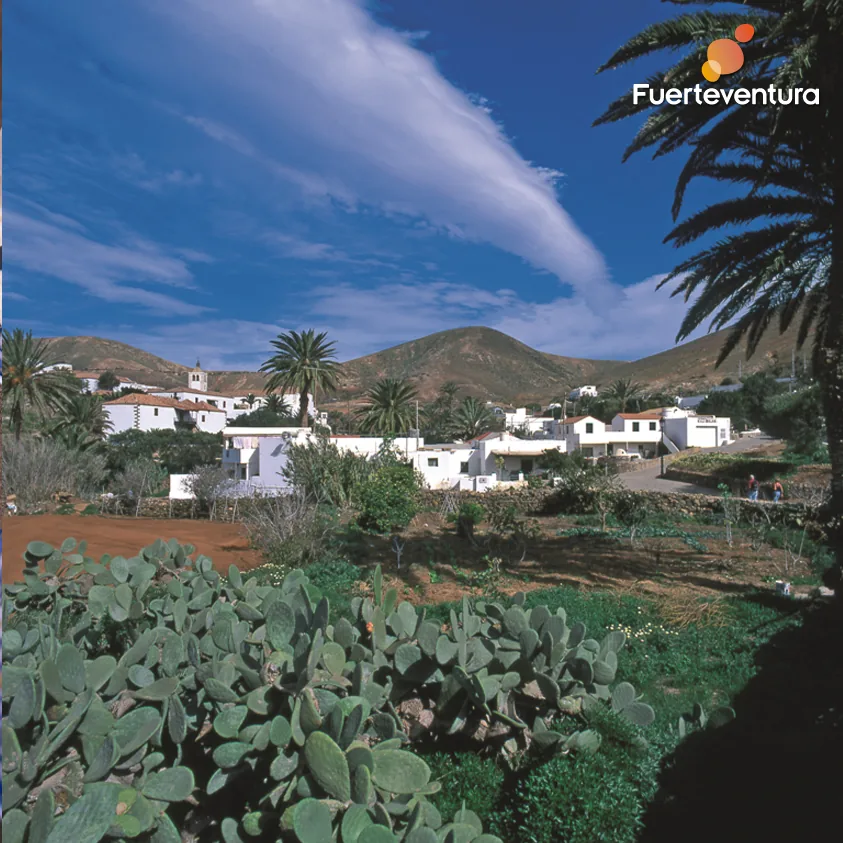
On an island associated with dunes, wind and open horizons, Betancuria is the exception: a green valley between mountains, cobbled streets, whitewashed houses and bougainvillea. It was the first capital of Fuerteventura, founded at the beginning of the 15th century by Jean de Bethencourt —from whom it takes its name— and for centuries it was the island’s political and religious centre.
The question everyone asks on arrival is why the capital of an island was built inland, with no sea view and no harbour. The answer is the one that explains half the history of the Canary Islands: to hide it from pirates. The valley is invisible from the coast, ringed by slopes that screen it on all four sides.
It did not entirely work. In 1593 a Berber raid reached this far, sacked the village and destroyed the church. What you visit today is, to a large extent, what was rebuilt afterwards.
How to get to Betancuria and where to park
Betancuria lies at the geographical centre of the island, deep in the central massif, and is reached by the FV-30 road, one of the loveliest in Fuerteventura: bends, viewpoints and a mountain landscape unlike anything on the coast.
about 25 minutes.
between 45 minutes and an hour, depending on whether you follow the coast or cut across the interior.
a good hour and a half. It is a full-day destination if you are coming from the south.
there is a public car park at the entrance to the village, next to the FV-30. It is best to leave the car there and walk in: the streets of the old quarter are narrow, cobbled and not designed for traffic.
What to see in Betancuria: the hour-and-a-half route
The historic centre can be covered on foot, and unhurried, in an hour and a half. The order that works best, starting from the car park:
- 1Calle de Roberto del Castillo
The main street, cobbled and lined with the best-preserved traditional houses. It is the picture-postcard view of the village.
- 2Iglesia de Santa María
The island’s former cathedral, rebuilt after the sacking of 1593. Inside it keeps altarpieces and a baptismal font that are worth the five-minute stop.
- 3Archaeological Museum
Small, but this is the place where you understand who the mahos were, the island’s inhabitants before the conquest, and why mountains such as Tindaya were sacred to them.
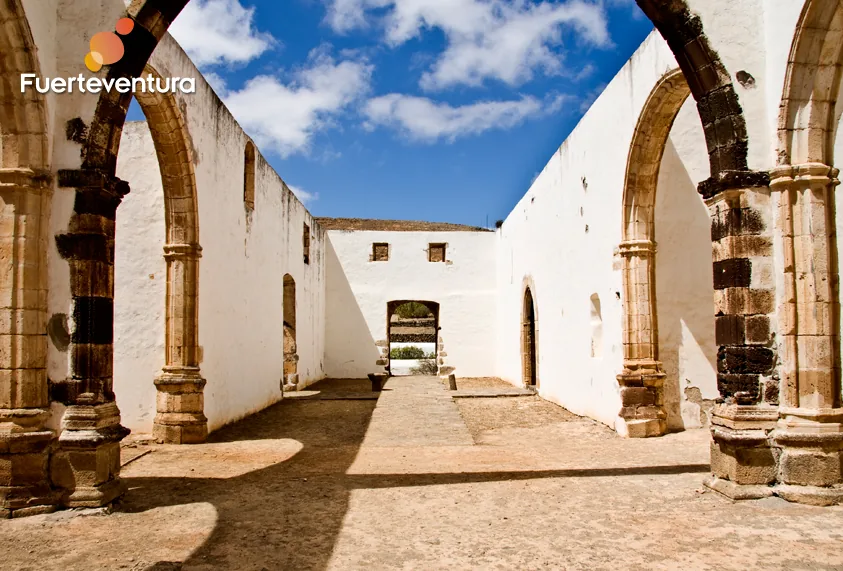
- 4Ruins of the Convento de San Buenaventura
On the way out of the village, the remains of the first Franciscan monastery in the archipelago. They stand in the open air, roofless and unsupervised, and are probably the most atmospheric corner of Betancuria.
When to go and what to expect
Betancuria is a small village that receives a lot of coach tours. That changes everything depending on the time of day:
Before 11am or after 4pm, the village is quiet and you can walk it almost alone.
Between 11am and 3pm is when the organised excursions coincide and when every shop and restaurant is open.
being inland and high up, it feels cooler than on the coast, especially at dusk. A light jacket is never wasted, not even in summer.
the cobbles are lovely but uneven. Closed shoes rather than flip-flops.
Eating in Betancuria
It is one of the best places on the island to stop for lunch, and it fits naturally into the middle of the route. What you eat here is inland majorero cooking: goat meat, puchero stew, gofio escaldado and queso majorero, the goat’s cheese that holds a Protected Designation of Origin and wins international awards with some regularity. If you want ideas for the rest of the island, we have our guide to where to eat in Fuerteventura.
What to see near Betancuria
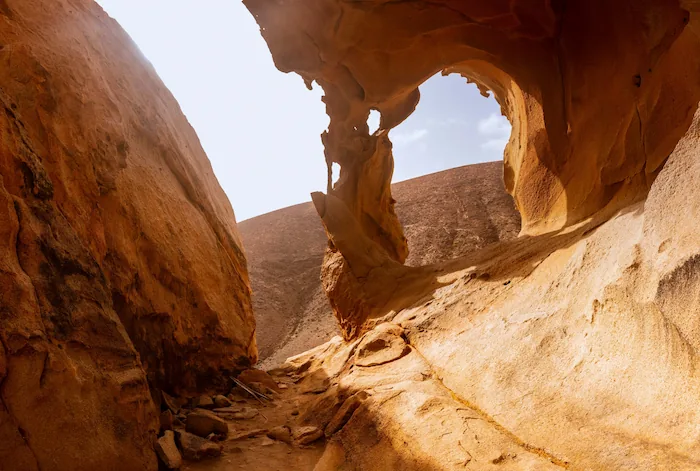
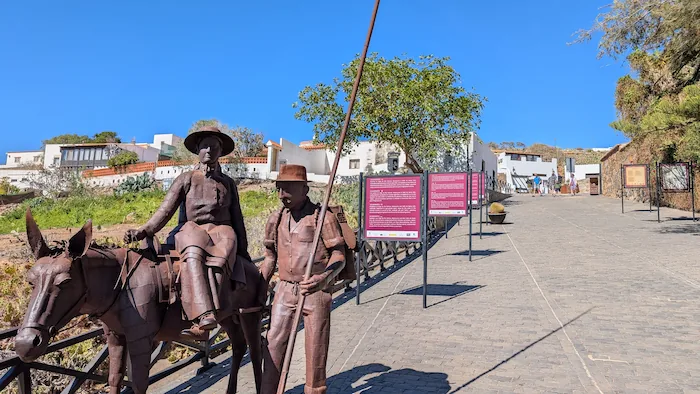
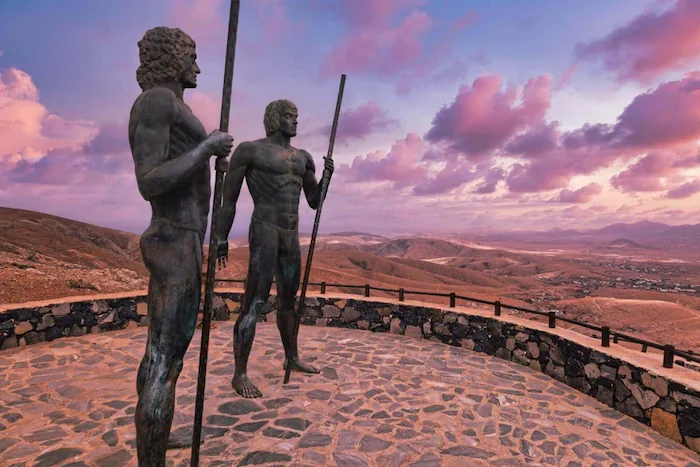
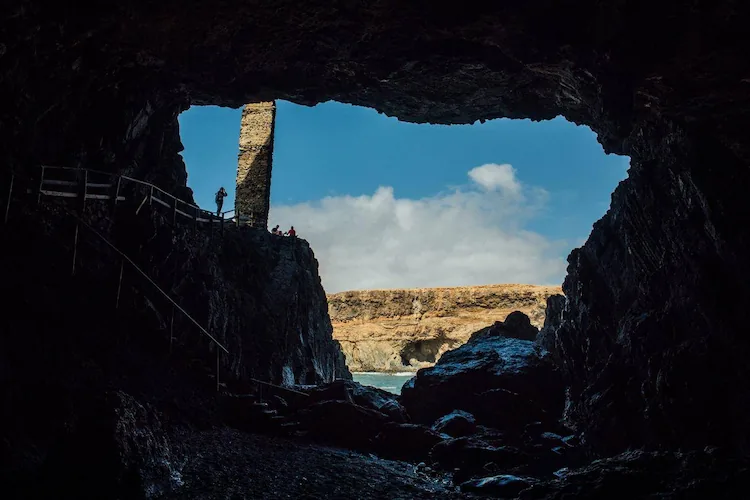
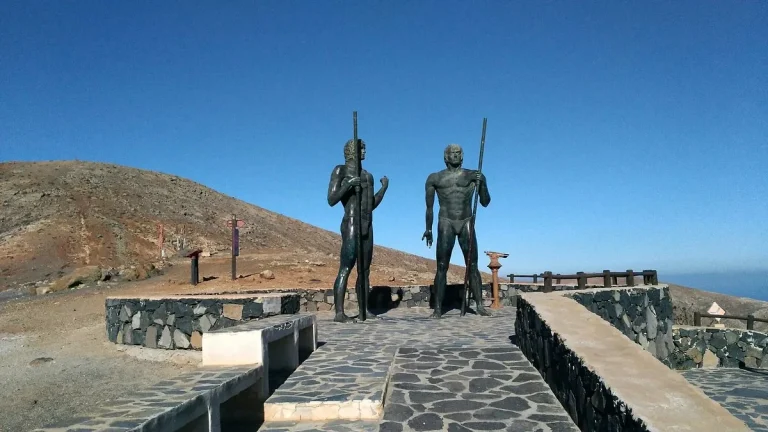
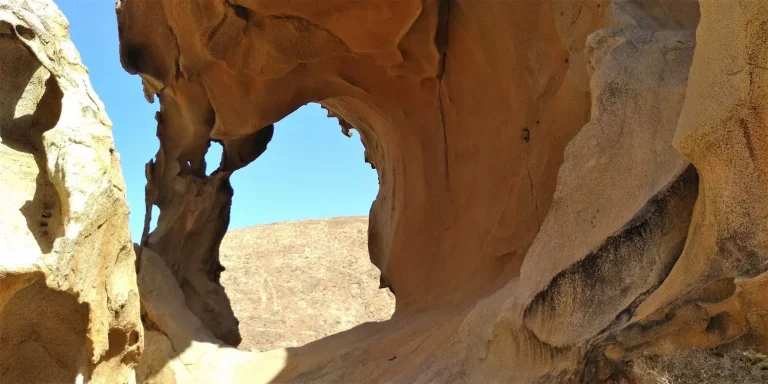
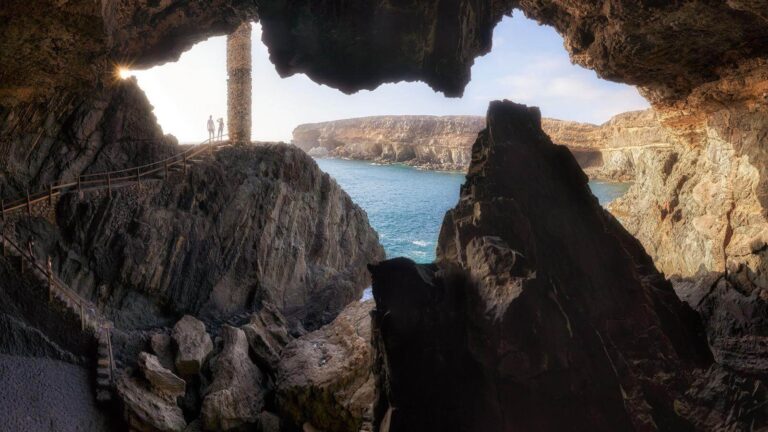
Betancuria is not a stop you make on its own: it is the centrepiece of the island’s inland route. On the same road, a few minutes away, is the Mirador de Guise y Ayose with the statues of the two aboriginal kings. Carrying on west you reach Vega de Río Palmas and the Arco de las Peñitas. And dropping down to the west coast you come to the Ajuy Caves. All four fit into a single day, and they are built into our 5-day route around Fuerteventura.
Frequently asked questions about Betancuria
How long does it take to see Betancuria?
An hour and a half covers the whole historic centre, including the church, the museum and the convent ruins. Add lunch and you are looking at three hours, and you will have seen the village at its best.
Is there an entrance fee?
Walking into the village and around its streets is free, as are the car park and the convent ruins. The museum and a few other visitable sites charge their own, nominal, admission.
What is the best time of year to go?
Any time, because it does not depend on swimming. Even so, the valley gains a great deal after the winter rains, when the slopes turn green and the contrast with the rest of the island is at its sharpest. In high summer the interior builds up more heat than the coast at midday, so it is worth going early.
Why is it said to have been the first capital of the Canary Islands?
Because it was the first town founded by the European conquerors in the archipelago, at the beginning of the 15th century, and for a long time it concentrated both political power and the bishopric. Centuries later the island’s capital passed to Puerto del Rosario, on the coast.
Can you get there by public transport?
There is a bus service linking the capital with the interior of the island, but the frequency is low and it is not designed for a sightseeing visit run to a timetable. For the central massif, a hire car is the practical option; the alternative is an organised excursion.
Is it suitable for children or a pushchair?
With children, yes: it is safe, mostly flat and short. With a pushchair the cobbles make it uncomfortable, although the main street is manageable.
Is it worth it if I only have one day inland?
Yes. If you have to choose a single stop in the centre of Fuerteventura, this is the one: it is the one that explains the island’s history and the only one that offers valley and mountain scenery with a village still lived in. You can see what else fits in what to see in Fuerteventura.
Keep exploring